TL;DR: Not all lines are the same, and the type you have changes which ingredient makes the most sense. Expression lines (also called dynamic wrinkles) show up when your face moves, like forehead lines, 11s, and crow's feet. Fine lines are shallow lines often linked to dryness and early loss of firmness, and they're visible even at rest. Over time, expression lines can become static lines that stay put. Argireline® is designed for the look of expression lines, Matrixyl 3000® for firmness and resting lines, and Hyaluronic Acid supports all of them by keeping skin hydrated.
Why Your Line Type Matters
If you've tried a "wrinkle serum" and felt underwhelmed, the formula might have been built for a different kind of line than the one you have. Different lines have different causes, so they respond best to different ingredients.
Skincare marketing tends to lump everything together as "fine lines and wrinkles." But a crease that appears only when you smile isn't the same as a line that's there when your face is completely relaxed. Knowing the difference helps you choose products on purpose instead of by trial and error.
What Are Expression Lines (Dynamic Wrinkles)?
Expression lines are lines that appear, or deepen, when your face moves. Dermatologists often call them dynamic wrinkles, because they come and go with your expressions.
They form in the places your face folds most often:
- Forehead lines: horizontal lines from raising your eyebrows
- 11s: vertical lines between your brows from frowning or concentrating
- Crow's feet: the fan of lines at the outer corners of your eyes from smiling and squinting
- Bunny lines: small lines on the sides of the nose when you scrunch it
Early on, these lines disappear when your face relaxes. They're a normal sign of an expressive face, and they're the lines Argireline was designed for.
What Are Fine Lines?
Fine lines are shallow, thin lines on the skin's surface that you can see even when your face is still. They often show up first around the eyes, cheeks, and mouth.
A few things contribute to them:
- Dehydration: dry skin shows fine, crinkly lines that often look softer once the skin is well hydrated
- Early loss of firmness: skin's support proteins, collagen and elastin, gradually decline with age
- Sun exposure: in a study of nearly 300 women, researchers estimated that sun exposure accounted for about 80% of visible facial aging signs [1]
Some fine lines are really dehydration lines in disguise. That's the good news: they're often the first to look better once hydration improves.
When Expression Lines Become Static Lines
With time, expression lines can stop disappearing when your face relaxes. Those are static wrinkles: lines that stay visible at rest.
It happens gradually. Years of the same folds, combined with skin that bounces back less easily, leave lines etched in place. The same study that measured sun's impact on skin found that wrinkles are shaped by both chronological aging and outside factors like UV exposure [1].
Many people over 35 have both: static lines that are always there, plus dynamic lines that deepen when they move. That's why a two-part approach often makes sense.
A Quick Mirror Test
You can check your own line type in about 30 seconds. All you need is a mirror and good light.
- Relax your face completely. Note any lines you can see.
- Raise your eyebrows, frown, then smile widely. Note which lines appear or get deeper.
- Relax again and compare.
- Lines that only appear with movement: dynamic, or expression, lines
- Lines visible at rest: fine lines or static lines
- Lines that are there at rest and deepen when you move: a mix, which is very common
Which Ingredient Fits Which Line?
Match the ingredient to the line: Argireline for the look of expression lines, Matrixyl 3000 for firmness and resting lines, and Hyaluronic Acid as the hydration base under both.
For expression lines: Argireline
Argireline (Acetyl Hexapeptide-8) is a lab-made peptide developed specifically for lines that come from movement [2]. In a randomized, placebo-controlled study on lines around the eyes, four weeks of twice-daily use of a 10% Argireline formula produced measurable improvement in the look of wrinkle roughness compared with placebo [3].
For fine lines and firmness: Matrixyl 3000
Matrixyl 3000 is a pair of signal peptides (Palmitoyl Tripeptide-1 and Palmitoyl Tetrapeptide-7), short protein fragments designed for the look of firmer, smoother skin. It's one of the most widely used peptide actives in anti-aging skincare [4], and it's designed for the look of firmness and resting lines rather than movement.
For every line type: Hyaluronic Acid
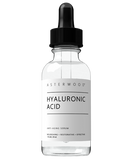
Hyaluronic Acid is a moisture-binding molecule your skin also makes: it draws water into the skin's surface layers and helps skin hold on to that moisture. Well-hydrated skin looks plumper right away, which softens the look of every line type. That's why every Asterwood formula starts with hydration.
For a side-by-side comparison of the two peptides, see Matrixyl vs. Argireline: Which Handles Expression Lines?
Building a Routine Around Your Line Type
Once you know your line type, choosing products gets simple. Here's how Asterwood's lineup maps to each situation.
- Mostly expression lines: Argireline Serum. 2% Argireline plus 1% Hyaluronic Acid in six ingredients.
- A mix of expression and resting lines: Matrixyl 3000 + Argireline Serum. 3% Matrixyl 3000 and 2% Argireline in one step.
- Lines plus uneven tone: Triple Repair Serum. Adds stable Vitamin C for a brighter, more even-looking tone.
- Mostly dehydration lines: start with Hyaluronic Acid Serum and a moisturizer, then add a peptide if lines persist.
That's the mix-and-match idea behind Asterwood: start with the ingredient that fits your skin, and build from there.
Whatever your line type, daily SPF protects the progress you're making [1].
How Your Lines Change With Age
Most people move through a similar pattern: dehydration and expression lines first, then lines that stay visible at rest. Knowing where you are helps you choose a routine that matches your skin now, not ten years from now.
- 20s: faint expression lines that disappear when your face relaxes, plus the occasional dehydration line. Hydration and daily SPF do most of the work.
- 30s: expression lines, especially crow's feet and forehead lines, start to linger a little longer. This is when many people add an expression-line peptide like Argireline.
- 40s and beyond: some lines become static, and firmness becomes a bigger concern. Pairing Argireline with Matrixyl 3000 covers both.
These are general patterns, not rules. Sun exposure, genetics, and how expressive your face is all shift the timeline, which is why the mirror test above is more useful than your birthday.
Setting Realistic Expectations
Topical peptides help visibly soften the look of lines over weeks of consistent use. They don't erase lines, and deep static lines typically change less than fine or dynamic ones.
The research says the same. A 2025 review of Acetyl Hexapeptide-8 notes that getting peptides through the skin's outer barrier is still a challenge, and that formulation plays a big role in results [5]. What you can expect is a smoother-looking, more refined surface and softer-looking lines, with the most visible changes after six to twelve weeks of twice-daily use.
Results may vary based on consistency, starting skin condition, age, sun exposure, and other factors.
This article is for educational purposes and does not constitute medical advice. Consult a licensed dermatologist for concerns specific to your skin.
Argireline® is a registered trademark of Lubrizol Advanced Materials (Lipotec). Matrixyl® 3000 is a registered trademark of Sederma.