Copper peptides — specifically GHK-Cu — have become the most-talked-about anti-aging ingredient of the last two years. TikTok made them famous. Clinical research made them trustworthy. This guide explains what copper peptides actually do, what the science says, how to use them, and how to layer them with the rest of your routine — without the hype.
What Are Copper Peptides?
Copper peptides are short chains of amino acids bound to a copper ion. The most-studied version — and the one you want in your skincare — is GHK-Cu, which stands for glycyl-L-histidyl-L-lysine-copper. It is a tripeptide (three amino acids) complexed with a single copper atom, and it occurs naturally in your own body.1
GHK-Cu was first isolated from human blood plasma in 1973 by Dr. Loren Pickart, who noticed that plasma from younger donors could make older liver tissue behave more youthfully in the lab. He identified the active compound as GHK-Cu and spent the next five decades documenting its effects on skin, wound healing, and gene expression.1
Here is the part that matters for your skin: your natural levels of GHK-Cu decline sharply with age. Plasma concentrations measure around 200 ng/mL at age 20 and drop to roughly 80 ng/mL by age 60 — a decline of more than 60%.1 That drop lines up almost perfectly with the slowdown in collagen production, skin repair, and wound healing most people start noticing in their 30s and 40s.
Topical copper peptides are designed to help replenish what your skin loses over time.
How GHK-Cu Actually Works
Most active ingredients do one thing. Copper peptides do several things at once, which is why they earn their reputation.
They signal fibroblasts to make more collagen and elastin. GHK-Cu binds to copper-dependent enzymes (including lysyl oxidase) that cross-link and stabilize new collagen. Research shows it stimulates the production of collagen types I, II, and III, plus elastin, dermatan sulfate, and decorin — all of the structural proteins that keep skin firm.1
They help clear damaged collagen while protecting the good stuff. GHK-Cu modulates matrix metalloproteinases (MMPs) — enzymes that break down old, damaged collagen — while also upregulating the inhibitors that protect healthy collagen.2 The practical result is proper remodeling: old damaged tissue out, new healthy tissue in.
They reduce inflammation. GHK-Cu lowers inflammatory signaling and supports the skin barrier, which is why it works well for reactive skin types and post-procedure recovery.1
They influence gene expression on a remarkable scale. Genomic research using the Broad Institute's Connectivity Map shows GHK-Cu modulates expression of over 4,000 human genes, activating repair and regenerative pathways associated with a younger skin profile.1 No other cosmetic peptide has this breadth of effect.
What the Clinical Research Actually Shows
Copper peptides are one of the most studied skincare ingredients in modern dermatology, with over four decades of peer-reviewed research. These are the studies worth knowing about.
Head-to-Head Against Vitamin C and Retinoic Acid
In a clinical study applying creams to thigh skin for 12 weeks, researchers tracked collagen production via skin biopsy.3 The results:
+ GHK-Cu increased collagen in 70% of women treated
+ Vitamin C cream increased collagen in 50% of women
+ Retinoic acid increased collagen in 40% of women
This is one of the few studies that put three gold-standard anti-aging ingredients side by side — and GHK-Cu outperformed both.
The 71-Woman Facial Cream Study
A 12-week facial study by Leyden and colleagues applied a GHK-Cu cream twice daily to 71 women with mild to advanced photoaging.4 Results showed improved skin laxity, clarity, and firmness, reduced fine lines and wrinkle depth, increased skin density and thickness, and reduced mottled pigmentation.
The Eye Cream Study
A companion 12-week study on 41 women with photoaged eye-area skin found GHK-Cu eye cream outperformed both placebo and vitamin K cream for reducing periorbital lines and improving skin density.4
Skin Thickness and Hydration
A pilot study on topical copper tripeptide complexes confirmed increases in both epidermal and dermal thickness, improved hydration, visible smoothing from stimulated collagen synthesis, and increased skin elasticity.2
These numbers should set realistic expectations: measurable structural change in 12 weeks of consistent use, with improvements continuing over 3–6 months.
Understanding Concentration: How Much GHK-Cu Do You Actually Need?
One of the counterintuitive findings in copper peptide research is that more is not better. GHK-Cu shows optimal effects at surprisingly low concentrations because at higher concentrations it also ramps up collagen-degrading enzymes.2 The goal is the sweet spot — enough to stimulate rebuilding without pushing breakdown past it.
Effective topical range: 0.05% to 2% GHK-Cu. Most cosmetic formulas sit in the 0.1–1% range and deliver results when used consistently.5
How to spot a real copper peptide product:
+ Look for "Copper Tripeptide-1" or "GHK-Cu" in the first third of the ingredient list
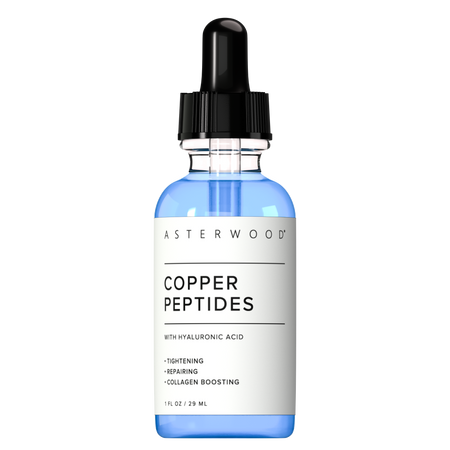
+ The formula should appear blue or blue-green — that color is the copper-peptide complex itself
+ Packaging should be opaque and airless (copper peptides are light- and oxygen-sensitive)
+ pH should sit in the 5.0–7.5 range for stability
For a deeper dive into the molecular science, check out our dedicated GHK-Cu ingredient page.
Copper Peptides for Men: Why the Looksmaxxing Crowd Got This One Right
Copper peptides have quietly become the #1 anti-aging ingredient among men focused on skin optimization — and the science backs the hype. Three factors make GHK-Cu particularly well-suited to male skin:
Skin thickness. Men's skin is about 20–25% thicker than women's on average, which means it holds collagen and elastin structure differently as it ages. GHK-Cu's ability to increase epidermal and dermal thickness2 reinforces the structural advantage men already have.
Healing and recovery. Active men — shaving, outdoor exposure, sports, procedures — benefit from GHK-Cu's well-documented wound-healing and barrier-repair effects.1 Translation: fewer razor bumps that linger, faster recovery from environmental damage, and better texture over time.
Simplicity. Copper peptides give you broad-spectrum anti-aging — firming, fine line reduction, healing, inflammation control — from one bottle. For anyone building a minimalist routine, that is the whole point.
Copper peptides are gender-neutral by design. The ingredient works the same way on any skin.
How to Use Copper Peptides: AM vs PM
Copper peptides work morning, evening, or both. The question is what you pair them with.
The simple approach (recommended for most people)
Evening only. Apply 3–5 drops of copper peptide serum to clean, damp skin, wait 1–2 minutes for absorption, then follow with moisturizer. This keeps your routine uncomplicated and avoids any layering conflicts with morning vitamin C.
The twice-daily approach
Morning: Cleanse → copper peptide serum → moisturizer → SPF 30+
Evening: Cleanse → copper peptide serum → other actives (like retinol, 2–3 nights per week) → richer night moisturizer
Daily SPF is non-negotiable. You are investing in collagen production; unprotected UV exposure degrades collagen faster than any ingredient can build it.
Layering Copper Peptides With Other Actives
Most layering questions about GHK-Cu have a clean answer. Here is the short guide.
Hyaluronic Acid — Ideal Pairing
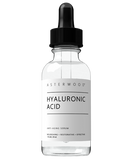
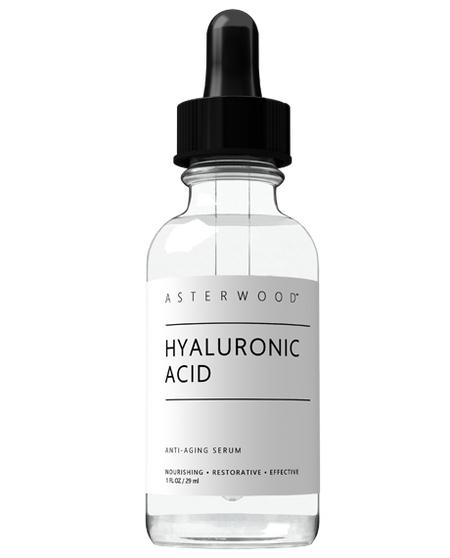
Hyaluronic Acid is the foundation of every Asterwood routine for a reason: it supports penetration and hydration for every other active. Apply Hyaluronic Acid Serum to damp skin first, then layer copper peptides on top. The HA creates the hydrated environment where copper peptides absorb and perform best.
Niacinamide — Fully Compatible
Despite old internet rumors that niacinamide and copper peptides cancel each other out, modern research and formulation practice show they pair well at cosmetic concentrations. Both reduce inflammation and support barrier function. Apply copper peptides first, niacinamide after.
Retinol — Better Together
Copper peptides and retinol stimulate collagen through different pathways (matrikine signaling vs. retinoic acid receptor activation), so they complement each other rather than compete. Use copper peptides nightly, add retinol 2–3 nights per week to start, and wait 10–15 minutes between applications. This combination reliably produces better results than either ingredient alone, without stacking irritation.
Vitamin C — Separate by Time of Day
This is the one pairing that needs care. Both vitamin C (L-ascorbic acid in particular) and copper peptides are oxidation-sensitive, and very low-pH vitamin C formulas can destabilize the copper-peptide complex. Simplest solution: vitamin C in the morning, copper peptides in the evening. You get both benefits, neither is wasted.
AHAs and BHAs — Separate Applications
If you are using exfoliating acids, apply them first, wait 15–20 minutes for skin pH to return to baseline, then apply copper peptides. Or alternate nights — acids one night, copper peptides the next.
What to Expect: A Realistic Timeline
Copper peptides are a "slow burn" ingredient. They do not deliver overnight results, but consistent use produces real structural change. Here is what the research and user experience consistently show:
Weeks 1–2 — Reduced inflammation, improved hydration, faster healing of any irritation or breakouts.
Weeks 3–4 — Skin starts looking calmer and more even. Texture improves subtly.
Weeks 6–8 — Fine lines start to soften. Skin feels firmer, looks more refreshed.
Weeks 10–12 — Visible reduction in wrinkle depth. This matches the timeline where clinical studies show their most significant results.4
Months 3–6 — Maximum collagen-building benefits. Skin density, firmness, and elasticity continue to build.
Commit to 12 weeks of consistent twice-daily use before evaluating results. Take a reference photo on day one so you have something objective to compare against.
Post-Procedure Use: An Underrated Benefit
Copper peptides are one of the most useful ingredients you can have on hand before or after an aesthetic procedure.
+ Microneedling: Begin use 24–48 hours after the procedure, once skin has sealed. GHK-Cu accelerates the collagen remodeling the treatment is designed to trigger.
+ Chemical peels: Resume use after flaking is complete to support healing and reduce post-inflammatory hyperpigmentation risk.
+ Laser treatments: Begin once skin has fully healed (typically 3–7 days post-treatment).
Always follow your provider's aftercare instructions first. Copper peptides complement professional treatments — they do not replace recovery protocols.
Safety and Side Effects
GHK-Cu has a strong safety record across more than 40 years of clinical use, and topical formulations are well tolerated across skin types.1 Most people experience no side effects. A small percentage may notice:
+ Mild tingling or flushing on application
+ Temporary breakout shift (usually resolves in 1–2 weeks)
+ Short-term textural change as cell turnover increases
Use with caution or skip if you have a known copper allergy or Wilson's disease (a copper metabolism disorder). If you are pregnant or breastfeeding, talk to your OBGYN before adding any new active ingredient, including copper peptides.
Copper Peptides vs. Other Anti-Aging Ingredients: The Short Version
vs. Retinol — Different mechanisms, gentler profile, no sun sensitivity. Best used together, not against each other.
vs. Vitamin C — Vitamin C is the antioxidant and brightener; copper peptides are the rebuilder. Morning vitamin C, evening copper peptides.
vs. Matrixyl 3000 — Both are signal peptides that stimulate collagen, but through slightly different pathways. They layer beautifully and produce better results together than either alone. (More on that combination in our Matrixyl 3000 vs Retinol guide.)
vs. Argireline — Argireline targets expression lines by relaxing muscle signaling; copper peptides rebuild structural collagen. Completely different mechanisms — they stack exceptionally well for comprehensive anti-aging.
Why Copper Peptides Fit the Asterwood Philosophy
Asterwood builds formulas around one principle: simple, clean, effective ingredients that earn their place in the bottle. Copper peptides are a textbook fit for that standard. GHK-Cu is a naturally occurring human peptide — your body already knows what to do with it. The copper is bound in a stable, bioavailable form. There is four decades of published research behind it. And at cosmetic concentrations, it produces measurable structural change without the irritation profile of harsher actives.
The ingredient also fits Asterwood's broader belief that good skin should not require a complicated routine. One bottle of well-formulated copper peptides delivers collagen stimulation, barrier support, inflammation control, and antioxidant protection — benefits that would otherwise require three or four separate products. That is the kind of compounding value Asterwood is built to deliver at prices anyone can sustain long-term.
The Asterwood Copper Peptides Firming Serum
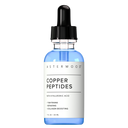
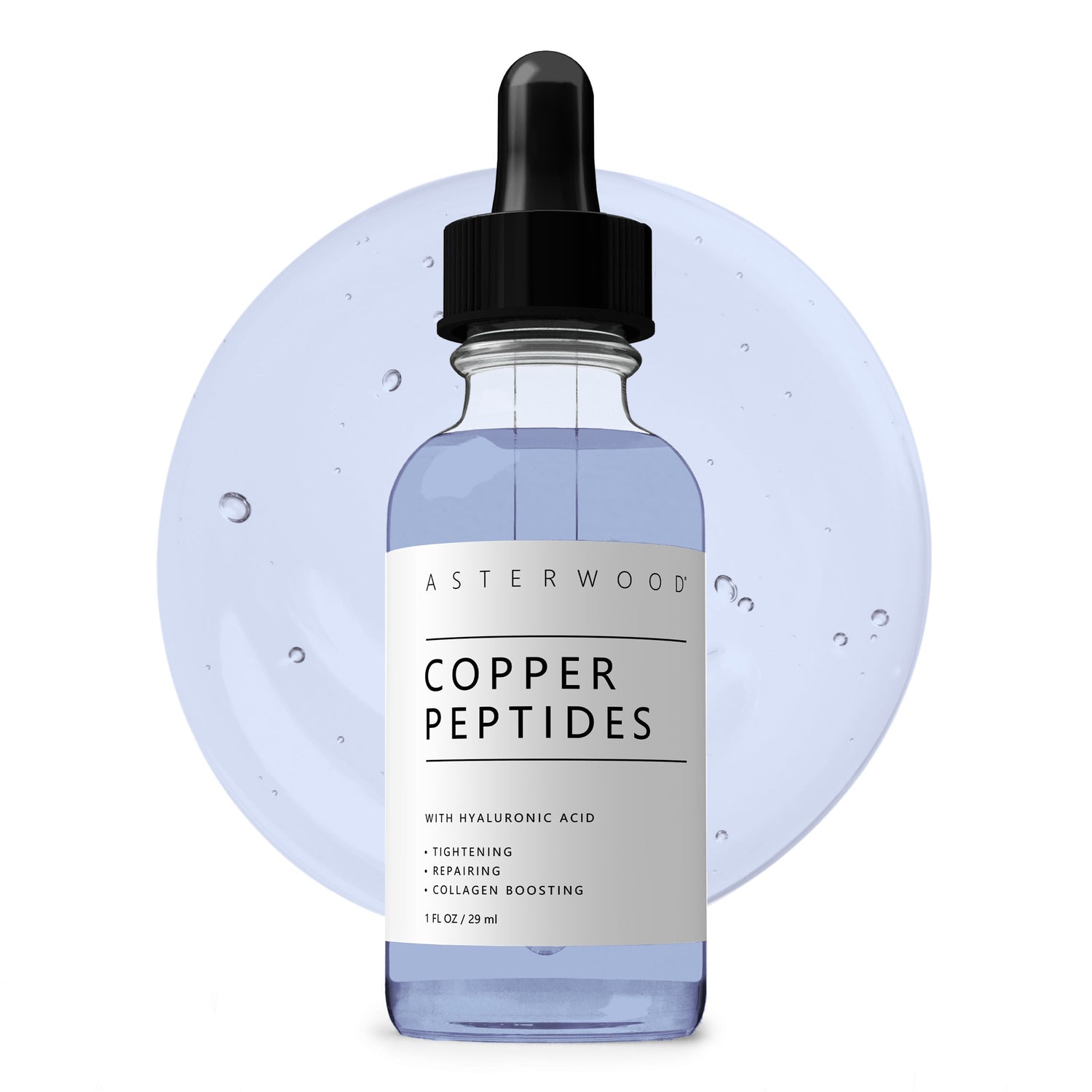
Asterwood's Copper Peptides Firming Serum features GHK-Cu in a Hyaluronic Acid base — the exact combination the research supports for penetration and stability. Clean, clinically effective, and priced at $19.99 so that twice-daily use for 12 weeks is actually realistic.
+ 1% Copper Peptides (GHK-Cu / Copper Tripeptide-1)
+ Hyaluronic Acid foundation for enhanced absorption
+ Fragrance-free, paraben-free, sulfate-free
+ Never tested on animals
+ Made in the USA of domestic and globally sourced ingredients
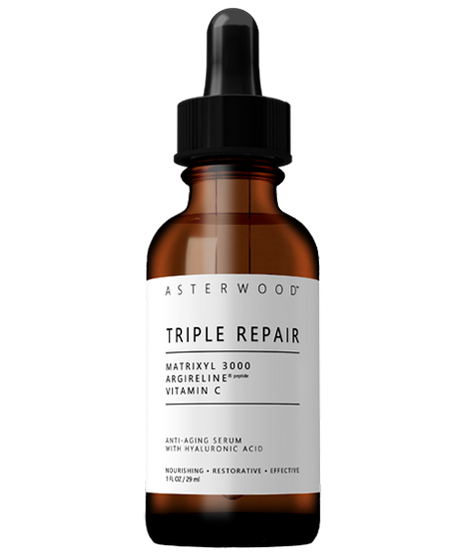
Pair it with Asterwood's Hyaluronic Acid Serum as your base layer, and layer our Matrixyl 3000 + Argireline Collagen Super-Serum morning and night for complete peptide coverage.
Frequently Asked Questions
How long does it take for copper peptides to work?
Initial improvements in hydration and inflammation appear in 1–2 weeks. Visible wrinkle and firmness improvements typically show up between weeks 6 and 12, matching the timeline in published clinical studies.4 Maximum results build over 3–6 months.
What percentage of copper peptides is in the Asterwood serum?
1% — which sits in the well-researched effective range for topical GHK-Cu and balances collagen stimulation against MMP modulation.
Can men use copper peptides?
Yes. GHK-Cu is gender-neutral. Men benefit from the same collagen stimulation, healing acceleration, and barrier support the research documents, and the ingredient performs especially well on thicker skin.
Are copper peptides better than retinol?
Different mechanism, different trade-offs. Retinol is faster and more aggressive; copper peptides are gentler and rebuild structure with less irritation. In head-to-head collagen studies, GHK-Cu outperformed retinoic acid (70% vs 40% of women showing increased collagen).3 The best answer for most people is to use both — together — through the week.
Can I use copper peptides with vitamin C?
Yes, but separate them by time of day. Vitamin C in the morning, copper peptides in the evening. This preserves the stability of both ingredients.
Will copper peptides help with hair?
Some evidence suggests GHK-Cu may support hair follicle function, but that is outside the scope of our topical skin formulas. If hair is your primary concern, seek a product specifically designed for the scalp.
Are copper peptides safe during pregnancy?
Data on topical copper peptides during pregnancy is limited. Talk to your healthcare provider before starting any new active ingredient during pregnancy or breastfeeding.
The Bottom Line
Copper peptides are one of the most-researched anti-aging ingredients in dermatology, with head-to-head data showing they outperform both vitamin C and retinoic acid for collagen stimulation.3 They are gentle, gender-neutral, and layer well with nearly every other active in your routine. They are not a miracle ingredient — nothing is — but given 12 weeks of consistent use, they deliver visible, measurable structural change.
Asterwood's philosophy is simple: clean formulas, clinically proven ingredients, attainable prices. Copper peptides fit all three.
Shop the Asterwood Copper Peptides Firming Serum →
References
- Pickart L, Margolina A. "Regenerative and Protective Actions of the GHK-Cu Peptide in the Light of the New Gene Data." International Journal of Molecular Sciences, 2018. pmc.ncbi.nlm.nih.gov/articles/PMC6073405
- Pickart L, Vasquez-Soltero JM, Margolina A. "GHK Peptide as a Natural Modulator of Multiple Cellular Pathways in Skin Regeneration." BioMed Research International, 2015. pmc.ncbi.nlm.nih.gov/articles/PMC4508379
- Abdulghani AA, Sherr S, Shirin S, et al. "Effects of topical creams containing vitamin C, a copper-binding peptide cream and melatonin compared with tretinoin on the ultrastructure of normal skin." Disease Management & Clinical Outcomes, 1998; 1:136-141.
- Leyden J, Stephens T, Finkey MB, Appa Y, Barkovic S. "Skin Care Benefits of Copper Peptide Containing Facial Cream." American Academy of Dermatology Meeting, 2002.
- Wikipedia contributors. "Copper peptide GHK-Cu." Wikipedia. en.wikipedia.org/wiki/Copper_peptide_GHK-Cu
This article is for educational purposes and does not constitute medical advice. Results from skincare ingredients vary based on skin type, concentration, formulation, and consistency of use. Consult a licensed dermatologist for concerns specific to your skin.