Matrixyl 3000 and retinol both promise smoother, firmer, younger-looking skin — but they take very different routes to get there. Retinol accelerates cell turnover. Matrixyl 3000 signals your skin to rebuild its own collagen. This guide breaks down exactly how each one works, what the clinical research shows, and which one is right for your skin — or whether the best answer is both.
The Short Answer
Retinol is the faster, more aggressive option with four decades of clinical data behind it. Matrixyl 3000 is the gentler, peptide-based alternative that works through a different mechanism and causes essentially no irritation. Neither ingredient "wins" in the absolute sense — they solve slightly different problems, and many people get their best results using them together.
The deeper answer depends on your skin, your tolerance for irritation, your stage of life, and whether you are willing to invest the 12 weeks of consistent use that both ingredients require. Let's break it down.
What Is Matrixyl 3000?
Matrixyl 3000 is a trademarked peptide complex developed by the French ingredient company Sederma. It combines two signal peptides: Palmitoyl Tripeptide-1 and Palmitoyl Tetrapeptide-7. Both are fragments of collagen-related proteins, modified with a palmitic acid (fatty acid) tail that helps them penetrate skin.1
Peptides are short chains of amino acids — the same building blocks your body already uses to make collagen, elastin, and every other structural protein in skin. "Signal peptides" like the ones in Matrixyl 3000 work by acting like a message to your fibroblasts: your skin is damaged, please rebuild. The fibroblasts respond by synthesizing more collagen, elastin, hyaluronic acid, and glycosaminoglycans.1
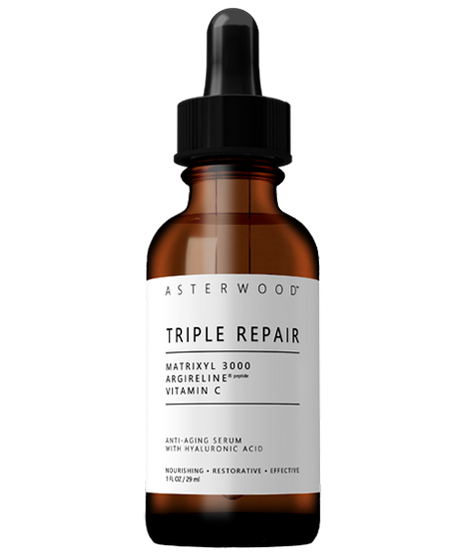
Matrixyl 3000 was one of the earliest matrikine peptide technologies on the market and remains one of the most widely researched. It appears in thousands of anti-aging formulations worldwide, including Asterwood's Matrixyl 3000 + Argireline Collagen Super-Serum.
What Is Retinol?
Retinol is the over-the-counter form of vitamin A. When applied topically, your skin converts retinol into retinaldehyde and then into retinoic acid (the active form, available by prescription as tretinoin). Retinoic acid binds to receptors in the cell nucleus and triggers a cascade of effects:2
+ Accelerates cell turnover
+ Stimulates new collagen synthesis
+ Inhibits collagenase (the enzyme that breaks down collagen)
+ Thickens the epidermis over time
+ Reduces hyperpigmentation by regulating melanin production
Retinol has more than 40 years of clinical evidence — tretinoin is still considered the dermatologic gold standard for treating photoaging.2 The trade-off is irritation: retinol is a potent active that commonly causes redness, flaking, dryness, and a "retinol uglies" adjustment period of 4–8 weeks. It is also not recommended during pregnancy or breastfeeding, and it makes skin more sensitive to sun.
How They Work: A Quick Side-By-Side
| Factor | Matrixyl 3000 | Retinol |
|---|---|---|
| Mechanism | Signals fibroblasts to rebuild collagen, elastin, and skin matrix | Binds retinoic acid receptors; speeds cell turnover, stimulates collagen, blocks collagen breakdown |
| Ingredient type | Peptide complex (two signal peptides) | Vitamin A derivative |
| Irritation risk | Very low — safe for sensitive skin | Moderate to high — purging, redness, flaking common |
| Sun sensitivity | No — can use AM and PM | Yes — PM only, daily SPF required |
| Pregnancy-safe | Yes (consult your provider) | No — contraindicated |
| Time to visible results | 6–12 weeks | 8–12 weeks after adjustment period |
| Best for | Wrinkles, firmness, sensitive or reactive skin, layering with other actives | Wrinkles, texture, photoaging, acne, hyperpigmentation — if your skin tolerates it |
| Research depth | Strong — ~20 years of published peptide research | Gold standard — 40+ years of clinical evidence |
What the Clinical Research Shows
Matrixyl 3000 Clinical Data
Matrixyl 3000's active peptides have been tested in both laboratory and human clinical studies. A pivotal Sederma-sponsored clinical trial of the complex reported, after 2 months of twice-daily use, a 45% reduction in deep wrinkle volume and a nearly 20% increase in skin tonicity.3 A separate clinical study of Palmitoyl Tripeptide-1 in 15 women showed statistically significant reductions in wrinkle length, depth, and skin roughness after 4 weeks of twice-daily application.1
Laboratory research confirms Matrixyl 3000 stimulates collagen types I, III, IV, and VII as well as fibronectin — meaning it helps rebuild the scaffolding that keeps skin firm.4
Practical takeaway: expect visible improvements in fine lines, skin firmness, and surface smoothness within 8–12 weeks of consistent use, with continued structural improvement building past the 6-month mark.
Retinol Clinical Data
Retinol and its prescription cousin tretinoin have the deepest clinical evidence base of any topical anti-aging ingredient. A 2016 study comparing retinol to retinoic acid found that 12 weeks of retinol treatment produced wrinkle reduction, keratinocyte proliferation, and molecular changes comparable to retinoic acid itself.5
A 2025 network meta-analysis of 22 randomized controlled trials across 3,801 participants confirmed retinol among the most effective topical anti-aging ingredients studied, with tretinoin producing the most robust and well-tolerated balance of efficacy and safety.6
Practical takeaway: retinol works, and it works well — but expect an adjustment period of 4–8 weeks during which your skin may look worse before it looks better.
Who Should Use Matrixyl 3000?
Matrixyl 3000 is the smarter choice for several specific situations:
Sensitive skin. Matrixyl 3000 is one of the most well-tolerated anti-aging actives in skincare. If retinol has burned you out in the past — literally — this is the peptide you want.
Pregnancy and breastfeeding. Retinoids are off the table during pregnancy. Peptides are generally considered safe (always consult your OBGYN), which makes Matrixyl 3000 a practical fill-in for the nine-plus months retinol is on pause.
Beginners to anti-aging. If you are just starting to think about anti-aging in your late 20s or early 30s, Matrixyl 3000 is a lower-commitment, lower-irritation place to start. You build collagen without the adjustment period.
Morning use. Retinol is a PM-only ingredient. Matrixyl 3000 is completely stable in daylight and works perfectly in your morning routine under SPF — ideal if you want collagen-supporting actives on around the clock.
Active layering. Matrixyl 3000 plays well with almost every other active ingredient, including vitamin C, niacinamide, copper peptides, and hyaluronic acid. If you are building a multi-active routine, it slots in easily.
Who Should Use Retinol?
Retinol earns its gold-standard reputation. Reach for it when:
You have well-established photoaging. Sun damage, coarse wrinkles, and pigmentation irregularities respond to retinoids better than any other topical ingredient. The evidence here is unambiguous.6
You also struggle with acne or clogged pores. Retinol accelerates cell turnover, which helps clear pores and treat acne on top of its anti-aging benefits.
You want more aggressive texture improvement. Retinol's cell-turnover effect smooths rough texture and visible pores more noticeably than peptides do.
You can commit to nightly use and diligent SPF. Retinol only works if you apply it consistently and protect the skin it is working on. If your morning SPF habit is spotty, start there before adding retinol.
Your skin can handle it. If you have sensitive or reactive skin, severe rosacea, or eczema, retinol may cause more damage than benefit. Start with peptides instead.
Can You Use Matrixyl 3000 and Retinol Together?
Yes — and for many people, this combination is where the magic happens.
The two ingredients stimulate collagen through different mechanisms. Matrixyl 3000 signals fibroblasts directly through matrikine signaling. Retinol triggers retinoic acid receptors in the cell nucleus. Because these pathways are independent, combining them produces additive, not overlapping, effects — more total collagen stimulation without doubling the irritation.
How to layer them
+ Morning: Cleanser → Hyaluronic Acid Serum → Matrixyl 3000 serum → moisturizer → SPF 30+
+ Evening: Cleanser → Hyaluronic Acid → Matrixyl 3000 serum → retinol → moisturizer
Apply Matrixyl 3000 first because it is the gentler ingredient and acts as a buffer. Wait 5–10 minutes before layering retinol on top. This reduces irritation without cancelling retinol's effect.
Start slow
If you are new to retinol, begin with retinol 2 nights per week alongside nightly Matrixyl 3000. Build to 3, then 4, then nightly as your skin adapts. Matrixyl 3000's barrier-friendly profile actually helps ease the retinol adjustment period.
Side Effects: The Honest Comparison
Matrixyl 3000 Side Effects
Clinical studies of palmitoyl peptides consistently report strong tolerability, with minimal reports of irritation, sensitization, or genotoxicity.1 Most people experience no side effects at all. The worst-case scenario is mild redness in those with extremely sensitive skin, which almost always resolves within a few days of use.
Matrixyl 3000 does not cause photosensitivity, so you can use it morning and night without increasing your sun sensitivity.
Retinol Side Effects
Retinol is a potent active with well-documented side effects, especially in the first 4–8 weeks of use:
+ Redness and flushing
+ Flaking and peeling
+ Dryness and tightness
+ Temporary increase in breakouts ("purging")
+ Stinging with application
+ Increased sun sensitivity
These effects usually subside as skin adapts. Starting at a low concentration (0.25–0.3%), applying 2–3 nights per week to start, and always following with a good moisturizer reduces irritation. Daily SPF is mandatory; without it, you are erasing the collagen you are building.
Pricing and Accessibility
Retinol products span a wide price range, from about $15 at the drugstore to $150+ at department store counters. Quality varies, but stable formulations in opaque packaging are the baseline requirement.
Matrixyl 3000 is similarly accessible, though well-formulated versions that use clinically relevant concentrations tend to sit in the $20–$40 range. Asterwood's Matrixyl 3000 + Argireline Collagen Super-Serum is priced at $23.99 and pairs Matrixyl 3000 with Argireline — a second peptide that targets expression lines through an entirely different mechanism — for stacked anti-aging coverage.
Matrixyl 3000 vs. Retinol vs. Peptide Stacks
A third option worth mentioning: peptide stacks. Instead of choosing between Matrixyl and retinol, or layering them both, some routines combine multiple peptides — Matrixyl 3000, Argireline, copper peptides — for a fully peptide-based anti-aging approach. This is particularly useful during pregnancy, for sensitive skin, or for people who tried retinol and simply did not tolerate it.
Asterwood's lineup supports this approach naturally:
+ Matrixyl 3000 + Argireline Collagen Super-Serum — dual peptide anti-aging, AM and PM
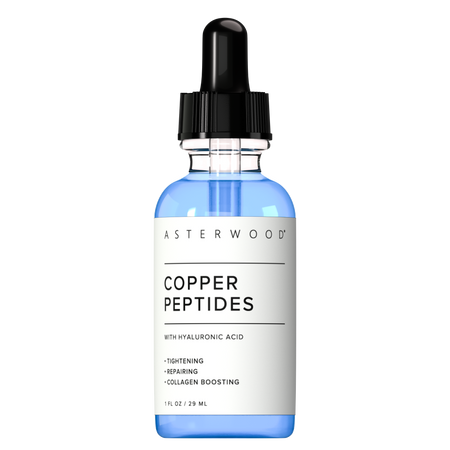
+ Copper Peptides Firming Serum — GHK-Cu for structural rebuilding, PM
+ Bakuchiol Smoothing Serum — plant-based retinol alternative, AM and PM
That stack covers the same collagen-building territory as retinol with essentially no irritation risk. Not faster than retinol — but a completely viable alternative for people who cannot or will not use it.
The Verdict: Which One Is Actually Better?
If your skin tolerates it, retinol gives you the fastest, most dramatic results thanks to 40+ years of clinical evidence and its multi-target mechanism. It is still the dermatologic gold standard for photoaging.2
If your skin is sensitive, reactive, pregnant, or retinol-intolerant, Matrixyl 3000 gives you a completely viable anti-aging alternative — gentler, daylight-compatible, pregnancy-safe, and excellent at stimulating collagen through a peptide pathway retinol cannot access.
For most people, the right answer is "both." Matrixyl 3000 morning and evening, retinol 2–4 nights per week. You get additive collagen stimulation through two independent mechanisms without stacking irritation — and that combination will outperform either ingredient on its own over the course of 6–12 months.
Whatever path you choose, three things stay the same: consistency, daily SPF, and patience. Collagen takes time to build. Commit to 12 weeks before you evaluate your results.
Shop the Asterwood Matrixyl 3000 + Argireline Collagen Super-Serum →
Frequently Asked Questions
Is Matrixyl 3000 as good as retinol?
For some people and some goals — yes. Matrixyl 3000 stimulates collagen through a different pathway than retinol and avoids retinol's irritation profile. It is not faster than retinol and does not address texture or pigmentation as aggressively, but it is a strong anti-aging ingredient in its own right, especially for sensitive skin or during pregnancy.
Can I use Matrixyl 3000 and retinol on the same night?
Yes. Apply Matrixyl 3000 first to clean, slightly damp skin. Wait 5–10 minutes, then apply retinol. Follow with moisturizer. This layering order uses Matrixyl's gentler profile as a buffer to reduce retinol irritation without cancelling its effect.
Does Matrixyl 3000 replace retinol?
For people who cannot tolerate retinol or are pregnant, Matrixyl 3000 is a strong replacement that works through collagen stimulation. For everyone else, it works best alongside retinol, not instead of it.
How long does Matrixyl 3000 take to work?
Clinical studies report measurable collagen density and wrinkle improvements at 8–12 weeks of twice-daily use, with continued improvement through 6 months.3 Be patient and consistent.
Is Matrixyl 3000 safe for pregnancy?
Peptides are generally considered lower-risk during pregnancy than retinoids, but always consult your OBGYN before introducing any active ingredient during pregnancy or breastfeeding.
Is Matrixyl 3000 safe for sensitive skin?
Yes. Clinical studies consistently report excellent tolerability across skin types, with minimal reported irritation or sensitization.1 Patch test any new product before full-face application.
What concentration of Matrixyl 3000 is effective?
Matrixyl 3000 is typically used at manufacturer-recommended concentrations (usually 3–8% of the Matrixyl 3000 complex in finished formulations). Because peptide activity depends on formulation stability, look for products from brands that specify their concentration and ship in opaque, airless packaging.
References
- Errante F, Ledwoń P, Latajka R, Rovero P, Papini AM. "Cosmeceutical Peptides in the Framework of Sustainable Wellness Lifestyle." Cosmetics, 2017; 4(2):16. mdpi.com/2079-9284/4/2/16
- Mukherjee S, Date A, Patravale V, et al. "Retinoids in the treatment of skin aging: an overview of clinical efficacy and safety." Clinical Interventions in Aging, 2006. pmc.ncbi.nlm.nih.gov/articles/PMC2699641
- Sederma. "Matrixyl 3000 — Technical Brochure and Clinical Data." Sederma is a division of Croda International Plc. Referenced clinical data summarized in Derma MD and industry reviews.
- Typology. "Palmitoyl Tripeptide-1 and Palmitoyl Tetrapeptide-7: The Peptides That Make Up Matrixyl 3000." typology.com
- Kong R, Cui Y, Fisher GJ, et al. "A comparative study of the effects of retinol and retinoic acid on histological, molecular, and clinical properties of human skin." Journal of Cosmetic Dermatology, 2016. onlinelibrary.wiley.com/doi/10.1111/jocd.12193
- "Comparative efficacy of topical interventions for facial photoaging: a network meta-analysis." Scientific Reports, 2025. nature.com/articles/s41598-025-12597-0
This article is for educational purposes and does not constitute medical advice. Retinoids are contraindicated during pregnancy and breastfeeding. Consult a licensed dermatologist or your OBGYN before starting any new active skincare ingredient.