We make a copper peptide serum at Asterwood, so we've spent more than a few years thinking about what makes one work. Most brands will tell you a serum has copper peptides; few tell you how much, in what form, or how to evaluate whether it's actually doing the job. Here are the five criteria we use when we look at any copper peptide serum — ours included.
The criteria that actually matter
If you've been shopping copper peptide serums for any length of time, you've noticed something: the marketing is loud and the ingredient lists are often vague. Most brands talk about transformation and clinical-grade actives without telling you the one thing that actually matters — how much copper peptide is in the bottle.
Here's what separates a serum that delivers visible results from one that's mostly hope and packaging: five criteria you can use to evaluate any copper peptide serum on the market — Asterwood's or otherwise.
1. Disclosed concentration of GHK-Cu
This is the most important criterion. Any brand serious about its copper peptide formula will share the concentration on the product page. If the label says "with copper peptides" but doesn't disclose how much, the active is typically present in very small amounts.
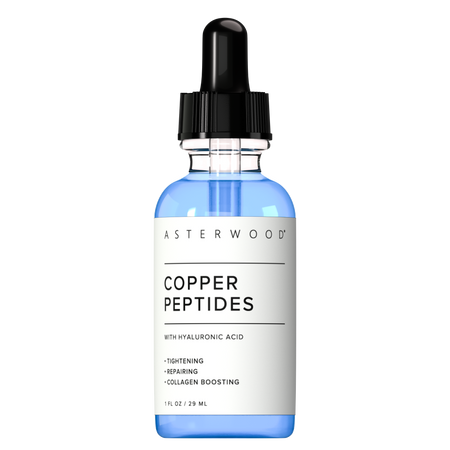
A meaningful concentration of GHK-Cu (Copper Tripeptide-1) is a specific number on the product page, not just "with copper peptides." Topical GHK-Cu has been studied across a wide range in published peptide research — from roughly 0.05% to 2% — but most clinical-grade daily-use serums sit in the 0.05% to 0.20% range [2]. That's where ingredient stability, gentleness, and consistent twice-daily use are all realistic. Asterwood's Copper Peptides Firming Serum sits at 0.10%, in the middle of that daily-use range.
2. Short, focused ingredient list
A general rule for active-led serums: shorter is better. Copper peptide serums with 6 to 10 ingredients give the active room to work. A serum with 25 to 30 ingredients buries the active in a long list of fillers, stabilizers, and texture modifiers that don't help the copper peptide do its job.
There are exceptions when the additional ingredients are deliberate complementary actives — a peptide blend formulated with niacinamide and ceramides, for example [4]. But more often, a long ingredient list signals that the formula is doing other things to justify its price tag, not making the copper peptide more effective.
The Asterwood serum has six ingredients total: Water, Pentylene Glycol, Phenylpropanol, Sodium Hyaluronate, Copper Tripeptide-1, Sodium Hydroxide. Nothing else. Simple. Clean. Effective.
3. INCI position consistent with the disclosed concentration
Ingredient lists are ordered by concentration, highest to lowest. Once you know the disclosed GHK-Cu concentration, you can check the ingredient list to see if the position lines up with what's claimed.
This is the criterion that catches the most marketing-to-reality gaps. A 0.10% active doesn't appear near the top of a long ingredient list — peptides are potent at small percentages, so even an effective dose sits toward the bottom regardless of how many ingredients are in the formula. What matters is the relationship between disclosure and position. A brand discloses a meaningful concentration and you find Copper Tripeptide-1 listed in the right neighborhood for that concentration: that's consistency. A brand features copper peptides on the product page but the active appears at the bottom of a long ingredient list with no disclosed concentration to anchor it: that's usually trace.
In Asterwood's six-ingredient formula, Copper Tripeptide-1 sits at position 5 of 6 — which is consistent with the disclosed 0.10%. There's no shorter way to write a formula like this, and there's nothing buried.
4. The color of the serum
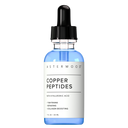
When it's properly formulated, GHK-Cu has a distinctive blue-green color. The copper bound to the peptide absorbs light in a way that produces the aqua tint [2]. A copper peptide serum that's clear, white, or any other color either uses very little of the active or has been color-corrected with additives.
The blue-green color is the visible signal that the active is present and the formula hasn't masked it for shelf appeal. Some shoppers find the color unusual at first, but once you know what it means it becomes one of the easiest visual checks in the category.
Asterwood's serum shows its natural blue-green because there's nothing to hide. If a copper peptide product looks like water, it's worth reading the ingredient list more carefully.
5. Fragrance, dyes, essential oils, and other irritants
None of these add anything to the copper peptide's effectiveness. All of them add irritation risk, particularly for sensitive skin. A clean copper peptide formula excludes these additives.
Fragrance — whether labeled as "parfum," "fragrance," or as individual essential oils — is one of the most common sources of skin reactions, especially on skin that's already responding to other actives in a routine. Dyes serve no functional purpose. The same applies to most "natural" botanical extracts that aren't doing measurable active work in the formula.
Asterwood's Copper Peptides Firming Serum is always formulated without:
- Parabens
- Sulfates and SLS/SLES
- Fragrance and essential oils
- Dyes and synthetic colorants
- Phthalates
- Dimethicone
The formula is vegan and cruelty-free. Always. For shoppers with sensitive skin, the absence of irritants is one of the strongest reasons the formula suits them — fewer triggers mean fewer reactions.
What to ignore in copper peptide marketing
A few common claims worth treating as noise:
- "Clinically proven" without the study cited. If a brand has done a clinical study, they'll link to it. Vague references to "clinically proven results" without supporting detail are marketing language. "Clinically studied ingredients" is a more honest framing.
- Long lists of patented complexes. A formula doesn't need eight branded peptide complexes to work. Sometimes that's a signal the formulator is hoping volume substitutes for concentration.
- Promised timelines that sound dramatic. Copper peptides are gradual. Anyone promising a transformation in two weeks is selling something else.
- Before-and-after photo galleries without context. Photos can be lit, edited, and filtered. Skin starting points vary too much for cross-person comparisons to mean much.
Attainable pricing without compromise
A meaningful copper peptide concentration doesn't have to be expensive. The most expensive serums in the category run $80 to $150 for a 1 oz bottle, and many of them disclose lower GHK-Cu concentrations than serums at a fraction of the price. You're paying for packaging and brand positioning.
The honest middle range is $20 to $40 for a 1 oz bottle with a properly disclosed, effective concentration. Asterwood's Copper Peptides Firming Serum is $21.99 at the 1 oz size — high-performing skincare at an attainable price point, with the active concentration delivered cleanly in six ingredients.
How the Asterwood Copper Peptides Firming Serum stacks up
When we built our serum, these five criteria were the brief. Here's how it lines up against each one:
- 0.10% GHK-Cu (Copper Tripeptide-1) — disclosed and in the effective range
- 6-ingredient formula — no fillers
- Copper Tripeptide-1 at position 5 of 6 — consistent with the disclosed concentration
- Naturally blue-green — no color masking
- Fragrance-free, no dyes, no essential oils, vegan, cruelty-free
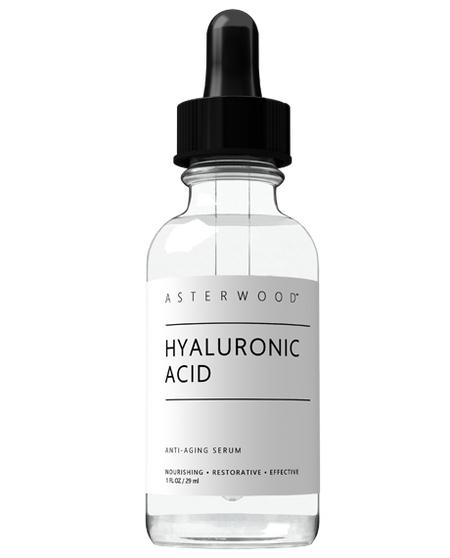
Paired with 1.50% Sodium Hyaluronate — the brand's foundation ingredient — the formula delivers immediate, lasting hydration while the copper peptides do their slower structural work in the background [1,3]. A natural polysaccharide humectant, Hyaluronic Acid retains moisture in the body and draws water into skin's upper layers for a plumper, more supple appearance.
Available in 1 oz, 2 oz, and 8 oz sizes at asterwood.co.
How to use what you've learned
Next time you're considering a copper peptide serum — ours or anyone else's — run it through the five criteria above. Most products won't pass all five. The ones that do are worth your time and money.
To go deeper on copper peptides themselves before deciding, GHK-Cu Copper Peptides: Benefits & Results Timeline covers what the active does, the realistic timeline, and how to integrate it into your routine. How to Use Copper Peptides: Morning vs. Night Routine gets specific on the AM and PM placement question.
This article is for educational purposes and does not constitute medical advice. Consult a licensed dermatologist for concerns specific to your skin.