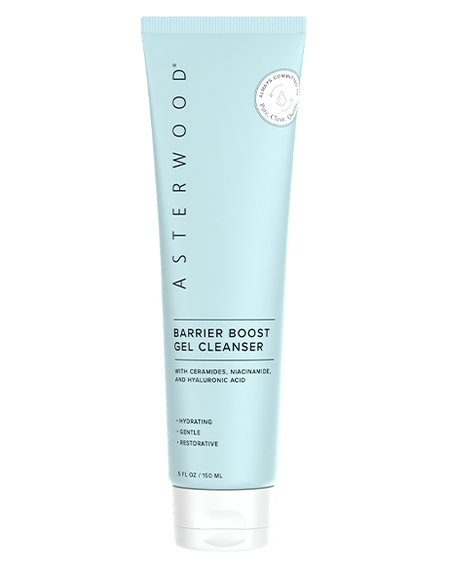
The complete guide to
Matrixyl 3000: The Wrinkle-Smoothing Peptide
Matrixyl 3000 is one of skincare's most-studied peptides for firmer, smoother-looking skin — which is why it anchors so many wrinkle-smoothing serums. Asterwood goes a step further, pairing it with Argireline to target the look of expression lines too, creating a single serum that works on both fronts: the fine lines you have now, and the expression lines that repeated movement creates. Two studied peptides, one easy step.
What it is
What Matrixyl 3000 Is
Short answer
Matrixyl 3000 is a branded, well-studied peptide complex (two peptides from Sederma) for visibly firmer, smoother, more even-looking skin. Asterwood pairs it with Argireline and Vegan Hyaluronic Acid in one clean, eight-ingredient serum.
Matrixyl 3000 is a branded peptide complex developed by Sederma — two peptides, Palmitoyl Tripeptide-1 and Palmitoyl Tetrapeptide-7, that work together for visibly firmer, smoother, more even-looking skin. It's one of the most-studied and most-used peptide complexes in all of anti-aging skincare, and that track record is exactly why Asterwood built a serum around it.
The two peptides are complementary — together they help skin look firmer, smoother, and more resilient the longer you use them. And because they work gently, you get that visible smoothing without the irritation, flaking, or sun sensitivity that stronger actives can bring.
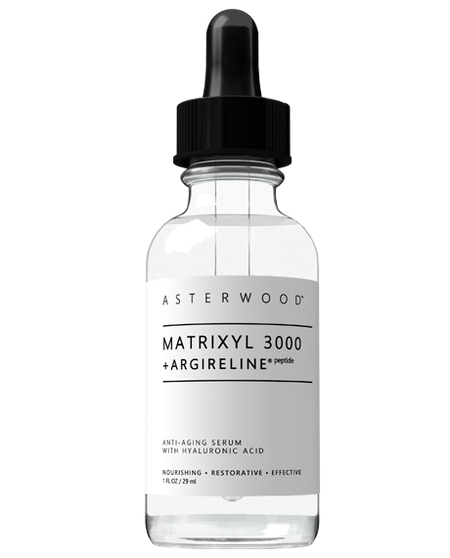
Asterwood's Matrixyl 3000 + Argireline Serum uses Argireline (Acetyl Hexapeptide-8) to soften the look of expression lines, plus Vegan Hyaluronic Acid to plump and hydrate. Just eight ingredients — fragrance-free, paraben-free, no dyes or essential oils. Simple. Clean. Effective.
What it does
What Matrixyl 3000 Promotes
Short answer
With consistent daily use, Matrixyl 3000 helps skin look visibly firmer and smoother while Argireline softens the look of expression lines.
Results may vary based on consistency, starting skin condition, and other factors.
What you can expect with continued, consistent use:
Visibly firmer-looking skin, day after day.
Softer-looking fine lines and a smoother overall surface.
Refined, smoother-looking texture with continued use.
A calmer, more even-looking complexion over time.
A calmer, more even-looking complexion over time.
Two peptides, more coverage
Matrixyl gives firmness a foundation and Argireline builds on it — together the two peptides cover more ground than either could alone.
Two targets, one serum
Matrixyl vs. Argireline
Short answer
Matrixyl works on firmness and fine lines; Argireline targets the look of expression lines. Most people have some of both — which is the whole case for one serum that delivers both peptides at disclosed strengths (3% Matrixyl 3000, 2% Argireline).
Repeated facial expressions create lines the same way folding paper in the same spot eventually creases it. Argireline is a peptide formulated specifically to soften the look of those expression lines — the forehead lines, crow's feet, and frown lines that come from everyday movement. It's one of the most popular peptides in skincare for exactly this reason, and it's a big part of why people reach for a peptide serum in the first place.
Matrixyl works on firmness and fine lines; Argireline works on the look of expression lines. Most people have some of both — which is the whole case for a serum that delivers both peptides in one step, at meaningful, disclosed concentrations, instead of making you choose.
The science behind the serum
Both peptides are backed by published research and rank among the most-used actives in anti-aging skincare. Matrixyl 3000 has a deep, consistent body of evidence for firmer, smoother-looking skin, and Argireline is one of the most-studied peptides for the look of expression lines. Asterwood pairs them at disclosed, meaningful concentrations — 3% Matrixyl 3000 and 2% Argireline — so you always know exactly what you're getting.
A 2020 peer-reviewed analysis found Matrixyl 3000's two peptides among the most frequently used in all of anti-aging cosmetics — a real signal of how much the category trusts them.[1] And a 2025 review highlights this peptide family as a gentler route to firmer, smoother-looking skin: often compared favorably with retinol, but without the irritation, dryness, or sun sensitivity retinol is known for.[2]
Argireline, for its part, is one of the most in-demand peptides in skincare for the look of expression lines. In the manufacturer's in-vivo testing, it visibly softened the appearance of expression lines in as little as one week of twice-daily use — and because it works on the surface look of lines, it stays gentle enough for everyday morning and night use.
The takeaway: two studied peptides, two different jobs, in one clean formula built to make daily use easy — which is what actually delivers visible results over time.
What to expect
The Matrixyl 3000 Results Timeline
Short answer
Skin feels smoother in the first 1–2 weeks; texture looks more refined by 3–4 weeks; firmness and softer-looking fine lines typically become noticeable at 6–8 weeks, with continued results at 12+ weeks.
- 1–2 weeks: Skin feels smoother, aided by Vegan Hyaluronic Acid.
- 3–4 weeks: Texture looks more refined as the peptides' smoothing benefits build.
- 6–8 weeks: Firmness and softer-looking fine lines typically become noticeable.[1,2]
- 12+ weeks: Continued, more complete results with sustained use.
Results may vary by skin type, age, sun exposure, and consistency of use.
How to use it
How to Add Matrixyl 3000 to Your Routine
Short answer
Apply a small amount to clean, dry skin, gently massage in, and follow with moisturizer. Use it morning or night — even both. No photosensitivity and no acclimation period, so it slots in from day one.
- Wash your face with a gentle cleanser.
- Apply a small amount into your palm or directly onto dry, clean skin.
- Gently massage in.
- Follow with a moisturizer.
- Patch test before your first full application.
Use it morning or night — even both. Unlike retinol, there's no photosensitivity to plan around and no acclimation period.
Layering
What Matrixyl 3000 Works With
Short answer
Compatible in the same step with Hyaluronic Acid, niacinamide, Vitamin C, and copper peptides. No known conflict with retinol, AHAs, or BHAs — just introduce those gradually on sensitized skin.
- Compatible in the same step: Hyaluronic Acid, niacinamide, Vitamin C, copper peptides.
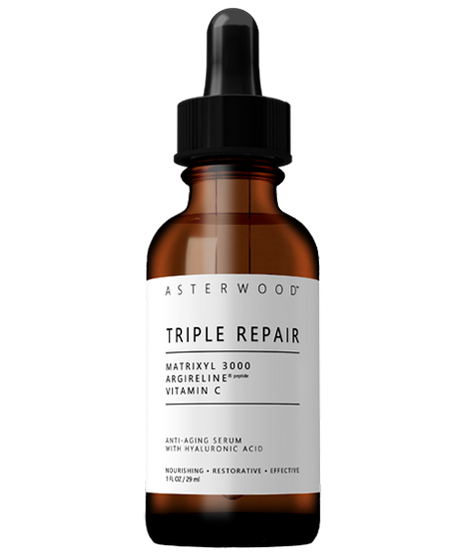
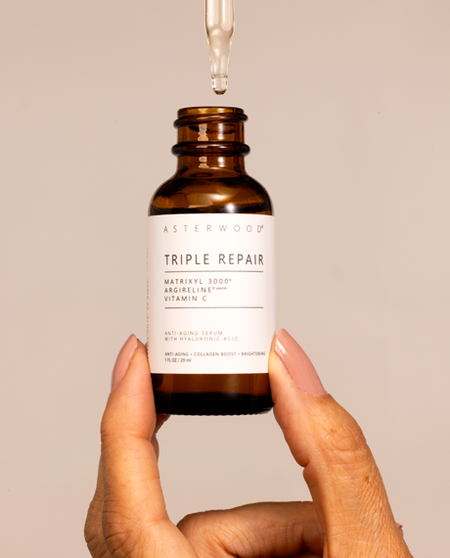
- Want brighter tone too? The Triple Repair Serum adds Vitamin C to the same base.
- Retinol, AHAs, BHAs: no known conflict, but introduce gradually on sensitized skin.
Explore Matrixyl 3000
Frequently asked
Common Questions
No — and that's exactly the point. Matrixyl supports firmer, smoother-looking skin; Argireline targets the look of expression lines. This serum gives you both peptides in one step.
Yes. It’s gentle enough for daily AM and PM use, with no acclimation period.
It's a topical peptide serum, not an injectable — so no needles and no downtime. With daily use it visibly softens the look of fine lines and expression lines, which is what most people are really after.
Yes — see the dedicated guide in this hub.
Asterwood pairs the two on purpose — you get firmness support and expression-line targeting in one step, so there’s no need to buy or layer two separate serums.
Peptides are a gentler path to firmer, smoother-looking skin — no irritation, flaking, or sun sensitivity — so they’re easy to use morning and night, every day. Plenty of people who can’t tolerate retinol reach for peptides for exactly that reason.
The science
Research Cited
References
- Ferreira MS, Magalhães MC, Sousa-Lobo JM, Almeida IF (2020). Trending Anti-Aging Peptides. Cosmetics, 7(4), 91.
- Badilli U, Inal O (2025). Current Approaches in Cosmeceuticals: Peptides, Biotics and Marine Biopolymers. Polymers, 17(6), 798.
- Zdrada-Nowak J, Surgiel-Gemza A, Szatkowska M (2025). Acetyl Hexapeptide-8 in Cosmeceuticals — A Review of Skin Permeability and Efficacy. Int J Mol Sci, 26(12), 5722.
This article is for educational purposes and does not constitute medical advice. Consult a licensed dermatologist for concerns specific to your skin.